

Finding a factory is easy. Determining whether the correct facility can manufacture the correct product to the correct specification with traceable evidence requires a different process.
A certificate can support validation, but it does not replace identity, scope, technical capability, documentation, and performance review.
Validation reduces uncertainty; it does not remove every risk or turn historical approval into current capability.
1. Confirm the exact legal entity and facility
Record legal name, trading name, facility address, country, contacts, and corporate domain. Compare these details across the quotation, certificate, license, bank account, invoice, and official directories.
A certificate issued to another facility, another group company, or a previous address must not be transferred automatically to the supplier under review.
2. Verify scope, not just the logo
ISO explains that it does not certify organizations or issue certificates; external certification bodies perform certification. ISO 9001 addresses a quality management system and does not mean that every product is certified.
For each document, check:
- issuing and accreditation bodies;
- certificate or license number;
- covered entity and address;
- standard and edition;
- declared scope;
- status and expiration;
- official verification directory.
For regulated sectors, use the applicable program directory. The API Composite List provides company, facility, certification, status, and product information. ASME provides a certificate-holder search with type, number, scope, and expiration details.
3. Separate management-system and product conformity
A facility may have a certified quality system and still need to prove that the offered item meets its specification. Request product-level evidence:
- controlled technical data sheet;
- approved drawing or datasheet;
- bill of materials where applicable;
- inspection and test plan;
- sample material certificate or test report;
- heat, lot, or serial traceability;
- marking and packing;
- deviation statement.
Evidence must match the offered reference, material, grade, size, and process, not merely a similar product.
4. Assess capability with recent evidence
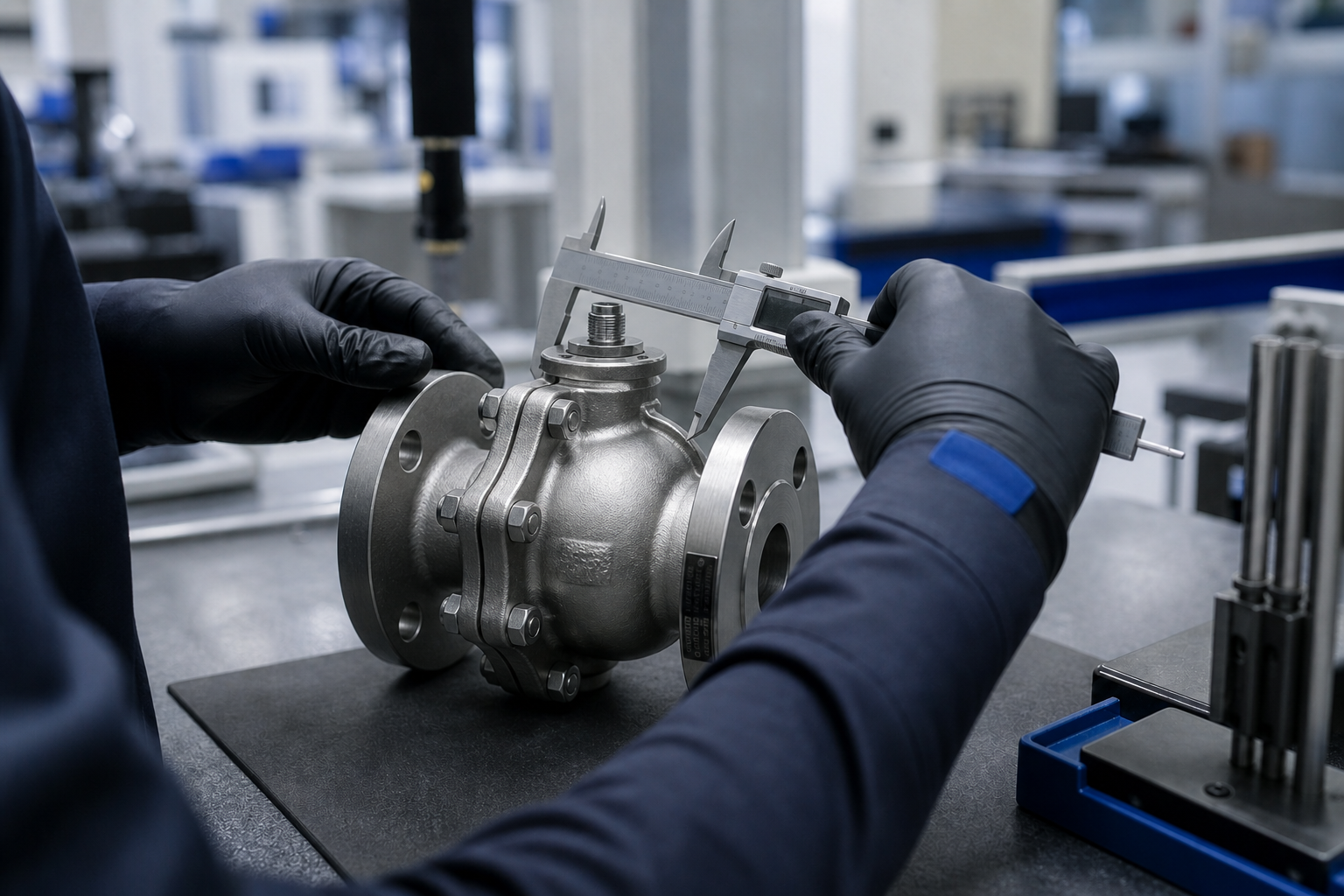
Do not infer capability from catalog photographs. Confirm internal and outsourced processes, relevant equipment, manufactured ranges, calibration controls, laboratory resources, competent personnel, and control of critical suppliers.
Use a progressive sequence when justified by risk:
- document review;
- technical meeting;
- sample or pilot order;
- remote or on-site inspection;
- defined testing;
- post-delivery performance review.
An audit should not focus only on housekeeping. It should compare observed capability with the offered product and process.
5. Validate documents before shipment
Define a document list and release points. Check names, quantities, dimensions, weight, marks, origin, lots, and consistency among packing list, invoice, certificates, and product.
Common sourcing and importing failures include:
- approving an offer without recording deviations;
- discovering third-party inspection requirements after production;
- inconsistent codes or descriptions across documents;
- certificates that cannot be traced to the lot;
- releasing shipment without checking packing, marking, or quantity;
- treating a historical relationship as current-state proof.
6. Classify evidence by currency
- Documented: an identifiable source supports the fact within its scope.
- Historical: it was true at an earlier date; useful background, not current confirmation.
- Current: recently verified and still within the applicable date, scope, and status.
- Declared: stated by the supplier but not yet corroborated.
- Unverified: insufficient evidence is available.
Apply this classification to certificates, products, ranges, capacity, markets, and availability.
7. Keep approval conditional and reviewable
Validation should produce a traceable decision:
- approved for a defined scope;
- conditionally approved with open actions;
- not approved;
- suspended pending new evidence.
Record product family, facility, processes, standards, limits, review date, reviewer, and next reevaluation. Approval for forged fittings does not automatically approve valves, pipe, or thermoplastics.
Warning signs
- Certificate absent from the official directory.
- Inconsistent address or legal name.
- Generic scope that does not cover the product.
- Refusal to disclose outsourcing or deviations.
- Reports without lot or sample identification.
- Photographs that cannot be tied to the facility.
- Bank-account change without independent verification.
- Fast commercial answers but evasive technical responses.
Closing
Manufacturer validation is not a collection of PDFs. It connects entity, facility, scope, process, product, and evidence. The result should be specific, dated, and reviewable.
Do you need to structure the assessment of a facility or international offer?
Let’s review your specification.Sources
- ISO, Certification, accessed 2026-08-27: https://www.iso.org/certification.html
- ISO/IAF Auditing Practices Group, Expected Outcomes for Accredited Certification to ISO 9001, accessed 2026-08-26: https://committee.iso.org/files/live/sites/tc176/files/documents/ISO%209001%20Auditing%20Practices%20Group%20docs/General/APG-ExpectedOutcomes2015.pdf
- API, Composite List, accessed 2026-08-27: https://mycerts.api.org/search/compositesearch
- API, Fraud Alerts, accessed 2026-08-26: https://www.api.org/products-and-services/api-monogram-and-apiqr/fraud-alerts
- ASME, Locate ASME Certified Companies, accessed 2026-08-27: https://www.asme.org/certification-accreditation/resources-and-events/locate-asme-certified-companies